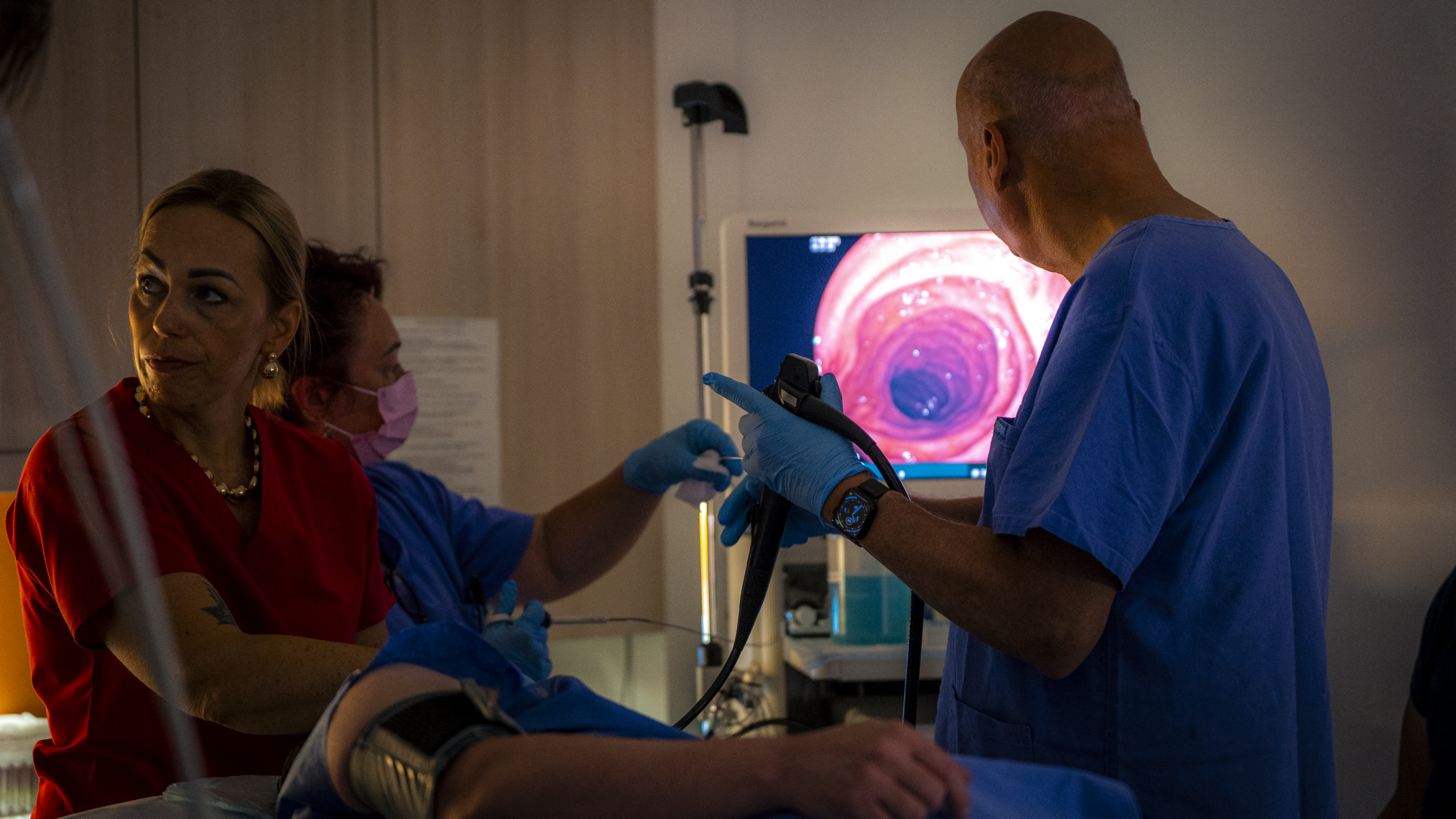
The aim of colonoscopy is to detect changes inside the bowel – such as polyps, narrowing, inflammation or even a tumour. Important procedures can also be carried out during colonoscopy: for example, bowel polyps that can lead to cancer can be removed, and tissue samples can be taken for histology.
You sleep through the examinationNo pain and no unpleasant memories afterwards.
Monitored by an anaesthetistVital functions monitored throughout the procedure.
CO₂ insufflationCarbon dioxide is absorbed 150 times faster than air.
Immediate polyp removalAny polyp we find is removed during the examination.
Eight situations where it is recommended
When is the examination recommended?
Colonoscopy is the most effective method of cancer prevention: precancerous polyps can be removed immediately during the examination. It is particularly recommended in the following situations.
For people over 45–50
A key screening examination even without symptoms, to prevent cancer in good time.
If there is a family history
If there is a family history of bowel polyps or cancer, regular check-ups are particularly important.
If you notice rectal bleeding
If fresh blood appears or a faecal occult blood test is positive, identifying the exact source is essential.
If your bowel habits change
Persistent constipation, diarrhoea or a sudden change in bowel habits calls for a thorough investigation.
For iron deficiency of unknown origin
This is the most reliable way to find hidden bleeding in the bowel that may be causing anaemia.
For chronic abdominal pain
The procedure is recommended to find the causes of recurring cramps, bloating or a feeling of tightness.
To monitor known bowel inflammation
In Crohn's disease or ulcerative colitis, the aim is to monitor the state of the inflammation.
For unexplained weight loss
It is crucial for ruling out absorption disorders or disease processes behind sudden weight loss.
Do any of these apply to you? Colonoscopy is also available under anaesthesia, without pain.
This list is for information only and does not replace an examination by a specialist. If you are unsure which examination you need, call us: 06-1-413-2500 (H–P 9–17).
Two routes, the same diagnosis
Colonoscopy with and without anaesthesia
Both procedures offer the same diagnostic accuracy — the difference lies in what you feel during the examination and how soon you can leave.
Under anaesthesia
Most popular choice
Completely painlessYou are asleep throughout the examination, so you experience no discomfort at all.
A stress-free experienceWith no anxiety and no unpleasant reflexes, the examination takes place in a calm setting.
Maximum relaxationRelaxed muscles help the doctor guide the instrument more easily and precisely.
No memories of the procedureThanks to modern anaesthetics, you are left with no unpleasant memories of the procedure.
Without anaesthesia
Awake throughoutYou remain conscious throughout, so you can respond to the doctor's questions straight away during the examination.
Active participationYou can follow the condition of your bowel on the monitor with your own eyes throughout the procedure.
Leave soonerNo recovery time is needed after the examination, so you can leave the clinic straight away, without a companion.
A cost-effective optionThis procedure is available at a lower price, as it does not require an anaesthetist.
From arrival to your report
The process step by step
Four steps: from bowel preparation to a personal explanation of your results.
01
Preparation (bowel cleansing)
A clean bowel is the basis of a successful examination. Following the low-fibre diet and taking the bowel preparation solution exactly as instructed gives the specialist a perfect view.
02
Anaesthesia and calm
Our specialists use a fast-acting agent, so you drift into a restful sleep. During the procedure, our anaesthesia team continuously monitors your vital functions.
03
A precise examination
Our doctor examines the bowel wall centimetre by centimetre using a modern video endoscope. Any polyps found are removed immediately and painlessly during the procedure.
04
Waking up and results
After a few minutes you wake up refreshed, and your doctor explains the findings in detail. You receive the results and the details of any tissue samples taken straight away.
If you have anaesthesia, please come with an adult companion and do not drive on the day of the examination. You will receive your exact arrival time and preparation instructions when you book.
Three reasons to choose anaesthesia
Why choose colonoscopy under anaesthesia?
01
Complete physical and mental comfort
The main advantage of the procedure under anaesthesia is that it completely removes fear of the examination and physical pain. Under deep sedation with an intravenous anaesthetic, you sleep undisturbed, so you are spared the cramps caused by the stretching of the bowel wall and the unpleasant feeling of bloating. This method not only rests the body but also removes emotional stress, turning a screening examination from a traumatic experience into a safe, unnoticed routine procedure.
02
Diagnostic accuracy and thoroughness
When the patient is under anaesthesia, the muscles relax completely and there are none of the involuntary reflexes that can make it harder to advance the endoscope. This calm state allows the gastroenterologist to focus fully on the smallest details of the bowel lining. Keeping still helps in spotting millimetre-sized polyps and precancerous conditions, significantly increasing the effectiveness of the examination and the accuracy of the diagnosis.
03
Immediate therapeutic procedures
During colonoscopy under anaesthesia, the specialist does not just examine but also acts straight away if needed. If a polyp or other change is found, a sample can be taken (biopsy) or the polyp removed immediately and painlessly while you are deeply asleep. This avoids a later, more complicated surgical procedure, as the diagnosis and preventive treatment happen in a single step, without any discomfort.
What you should know about colonoscopy
Did you know?
Ten questions and answers about colonoscopy under anaesthesia.
Did you know that colonoscopy is one of the most effective cancer prevention examinations?
A large proportion of tumours develop from benign polyps over 5-10 years. During colonoscopy these polyps can be detected and removed immediately, so the development of cancer can practically be stopped.
Did you know that after an examination under anaesthesia you have no memory of the procedure?
The deep sedation used at Endomedix means you sleep through the entire procedure. When you wake up, you have no unpleasant memories, pain or uncomfortable reflexes associated with the examination.
Did you know that modern anaesthetics leave the body extremely quickly?
After deep sedation, you wake up quickly and with a clear head. Most of our patients are alert and rested just 15-30 minutes after the examination and, after a short period of observation, can go home with a companion.
Did you know that the carbon dioxide gas used at Endomedix reduces bloating after the examination?
Compared with ordinary air, carbon dioxide is absorbed through the bowel wall 150 times faster. This means that the feeling of tightness and abdominal bloating after the examination is kept to a minimum or does not occur at all.
Did you know that polyp removal during the examination is completely painless?
Since the inner wall of the colon has no pain receptors, removing polyps or taking samples cannot be felt. And under anaesthesia, the patient does not even feel the instruments being moved.
Did you know that anaesthesia allows the doctor to make a more precise diagnosis?
When the patient's muscles relax completely under anaesthesia, the bends of the bowel become easier to pass through. This helps the gastroenterologist examine even the most hidden corners thoroughly.
Did you know that your diet before the examination is key to an accurate result?
A clean bowel wall is the basis of a successful endoscopy. The low-fibre diet and proper bowel preparation ensure that the doctor can spot even millimetre-sized changes on the monitor.
Did you know that an HD-quality video recording is made during colonoscopy?
Modern video endoscopes provide a high-resolution, digitally enhanced image. This technology also makes it possible to examine the blood vessel pattern of the mucosa, which helps in the early detection of inflammation and tumours.
Did you know that a single examination can give you peace of mind for up to 10 years?
If everything is found to be normal during screening and there is no family history, the next routine colonoscopy is usually only needed after 10 years.
Did you know that with a combined endoscopy, the entire digestive tract can be checked under a single anaesthesia?
At Endomedix, you can have gastroscopy and colonoscopy performed at the same time. This is the most efficient option, as the entire digestive system can be examined with a single preparation and a single anaesthesia, saving you time and answering all your digestive questions at once, while you sleep undisturbed throughout.
One anaesthesia, the entire digestive system: gastroscopy and colonoscopy can also be booked together.
The examination fee can of course also be paid from your health fund account — our colleagues will be happy to give you the details. The list of health funds that work with Endomedix can be found here.
Health fund accountThe colonoscopy and anaesthesia fees can both be paid from your health fund account.