In gastroscopy and colonoscopy under anaesthesia, the two examinations are performed at the same time – more precisely, one straight after the other – under anaesthesia.
30–45 minutesThat is how long both examinations take together, in experienced specialist hands.
Anaesthesia monitored throughoutWith an infusion pump, under the continuous supervision of a specialist anaesthetist.
CO₂ insufflationCarbon dioxide is absorbed quickly — no painful bloating after the examination.
10 centresFrom Budapest to Debrecen — the examination is available across the country.
Eight signs you should not put off
When is the examination recommended?
Not every complaint is caused by a serious illness — but uncertainty is worse than any result. In the following cases, gastroscopy and colonoscopy provide answers under a single anaesthesia.
Persistent abdominal pain and bloating
If you regularly experience lower abdominal cramps of unclear origin, tightness or troublesome bloating that does not go away on its own, it is worth having the underlying cause investigated.
Changes in bowel habits
Persistent constipation, diarrhoea or an unexplained alternation between the two may point to a more serious bowel problem — please get in touch with us.
Frequent heartburn and reflux
Recurring acid regurgitation, pain around the upper stomach or persistent hoarseness are often caused by reflux disease.
Blood in the stool or hidden bleeding
This requires immediate medical investigation: endoscopy rules out inflammatory processes, polyps and tumours.
Unexplained weight loss and iron deficiency
Unexplained weight loss and recurring iron deficiency may point to a digestive absorption disorder or chronic bleeding.
Suspected chronic bowel inflammation
Diagnosing Crohn's disease and ulcerative colitis requires endoscopy combined with tissue sampling for histology.
Over 45–50: cancer screening
Recommended even without symptoms. Colorectal cancer is one of the most preventable types of cancer: a polyp can be removed during the examination itself.
Family history and follow-up
With a family history of cancer or after previous polyp removal, regular follow-up endoscopy is recommended at the intervals set by your doctor.
Does any of this sound familiar? Gastroscopy and colonoscopy can be performed together under anaesthesia, in a single session.
This list is for information only and does not replace an examination by a specialist. If you are unsure which examination you need, call us: 06-1-413-2500 (H–P 9–17).
Good preparation is half the battle
Preparation and dietary advice for the examination
Without a perfectly clean bowel, even the best endoscope cannot see everything. There are three things to watch in the days before the examination — your specialist will give you the exact schedule.
01
Special diet and bowel preparation
In the days before the examination, you need to follow a specific diet that helps empty the bowel. Our specialist chooses the most effective laxative for your needs, which gently but thoroughly cleans the sections to be examined.
02
Maintaining electrolyte balance
The modern isotonic solutions used for preparation ensure that your body does not lose important minerals. We maintain your electrolyte balance during cleansing too, so weakness can be avoided.
03
Hydration and energy levels
Keep an eye on your energy levels during bowel preparation too. Instead of solid food, drink plenty of strained, clear fluids — this helps prevent weakness and dizziness while ensuring a perfectly clean bowel.
What you can safely drink during bowel preparation
Clear, transparent fluids instead of solid food — plenty of them, spread throughout the day.
Strained clear broth
Still water
Light-coloured tea
You will receive detailed, personalised preparation instructions when you book your appointment.
Your diet and laxative are always decided by your specialist — please follow the written instructions you receive. If you have any questions about the preparation, call us: 06-1-413-2500 (H–P 9–17).
Two examinations, half the preparation
Why it is worth having both examinations at once
Done separately, gastroscopy and colonoscopy mean two diets, two anaesthetics and two days off. Together, it takes a single morning — and gives a much more accurate picture.
1
You only need anaesthesia once
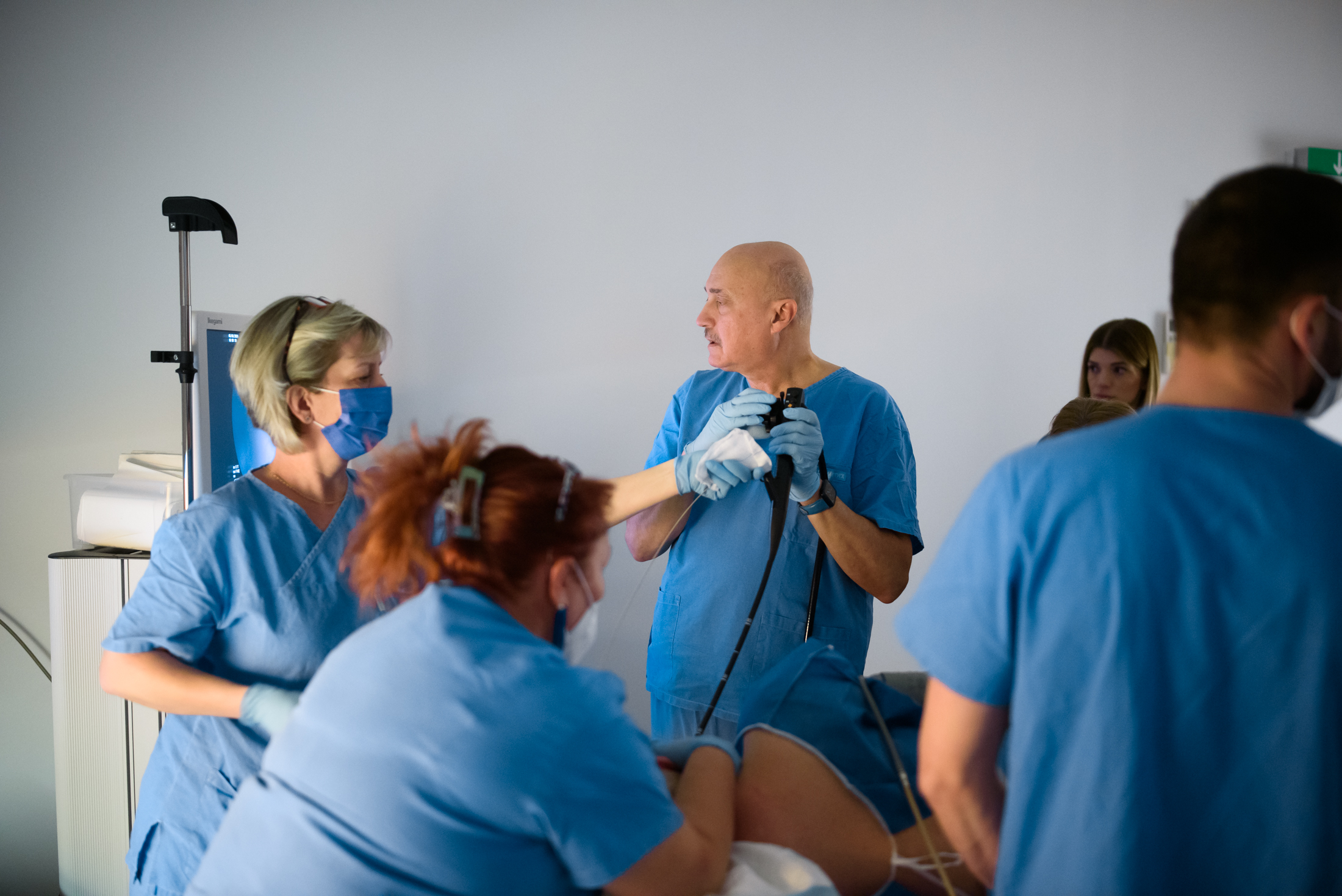
The main advantage of the combined examination is that you only have to go under once. Our specialist anaesthetist monitors the whole process while both examinations are carried out comfortably and completely painlessly.
2
The unpleasant preparation only once
The diet and laxatives before endoscopy are the least popular part of the process. If you ask for both examinations at once, you only have to go through bowel preparation once, saving you a great deal of time and discomfort.
3
A complete picture of the digestive system
Symptoms are often connected, and examining the entire digestive system together gives a much more accurate diagnosis. Our doctors can see the condition of the upper and lower sections at the same time, which helps them draw up the most effective treatment plan.
Save time and energy: two examinations, half the preparation, zero discomfort.
What patients ask most often
Did you know?
Ten common questions about endoscopy under anaesthesia — from fears to the driving ban. Click a question to see the answer.
You will not remember anything after the examination under anaesthesia
Many patients are afraid of an unpleasant experience, but thanks to the amnesic effect of the drugs used for anaesthesia, you will not perceive anything of the procedure. You wake up as if from a restful sleep, spared any physical discomfort, nausea or gagging, and you will have no memory of the examination at all.
Gastroscopy and colonoscopy together take only 30–45 minutes
Although examining the entire digestive system may sound complicated, in experienced specialist hands the combined procedure is extremely quick. This short time is enough to check every critical point from the oesophagus to the rectum, take samples, or even remove any small polyps we find straight away.
You can eat light food just an hour after the examination
Many people worry about a long period of fasting, but the good news is that after a short observation period once you wake up, you no longer need to go without food. We recommend starting with fluids, then light, gentle foods, so that your digestive system can gradually and comfortably get back to normal.
You must not drive for the rest of the day after a procedure under anaesthesia
Although you may feel alert and refreshed as soon as you wake up, the anaesthetic can still slightly affect your reflexes and judgement. That is why you must come with a companion, and for your safety you must not drive or do any work requiring responsibility on the day of the examination.
Removing polyps during the examination is completely painless
If the doctor finds a polyp during the endoscopy, it can be removed immediately with special instruments. Since the inner surface of the bowel wall has no pain receptors, you feel nothing of this therapeutic procedure. This step is crucial, because removing polyps can prevent cancer from developing.
Menstruation does not prevent you from having a colonoscopy
A common question among women is whether their cycle affects the appointment. From a medical point of view, menstruation is not a reason to postpone: with a tampon, the examination can be carried out hygienically and safely. However, if the associated cramps are very strong, please let our staff know when booking your appointment.
This examination often reveals the real cause of iron deficiency
The iron deficiency behind persistent tiredness is often caused by hidden bleeding that cannot be seen by other methods. During gastroscopy and colonoscopy, our doctors can pinpoint even tiny sources of bleeding, so that alongside iron supplementation the root of the problem can finally be dealt with.
Modern laxatives are much easier to tolerate
The days of large quantities of unpleasant-tasting liquids are over. Today we provide modern preparation products that clean the bowel effectively in smaller quantities and taste better too. Proper cleanliness is essential for our doctor to see even millimetre-sized changes.
The CO₂ gas used during the examination prevents bloating
At our clinic, we use special carbon dioxide gas to expand the bowel during the examination. Because this gas is absorbed by the body much faster than room air, you will not experience painful tightness or abdominal cramps after the procedure. This technology ensures a quick and comfortable journey home.
Bacteria can also be detected in a sample taken during gastroscopy
A tiny tissue sample taken during the examination can confirm the presence of Helicobacter pylori within minutes. This bacterium is responsible for a large proportion of inflammation and ulcers, so after an immediate diagnosis we can prescribe you a targeted course of antibiotics to prevent more serious digestive problems.
From arrival to your report
How gastroscopy and colonoscopy are performed
Four steps, one morning. You will always know what comes next — and when you can go home.
01
Consultation
When you arrive, our specialist and our anaesthetist go through the exact course of the examination with you. You get answers to all your questions, so you can begin the diagnostics feeling completely calm.
02
Falling asleep quickly and peacefully
In the examination room, our anaesthetist gives you a gentle anaesthetic, and within moments you drift into a deep sleep. This way you will feel nothing of the procedure, completely avoiding pain and unpleasant sensations.
03
Precise diagnostics
While you are asleep, our doctor performs the endoscopy using modern equipment. If we find a suspicious change or a polyp, we remove it immediately and painlessly, effectively preventing more serious problems later on.
04
Waking up and the expert report
After the examination, you wake up in our comfortable recovery area, where our staff monitor you continuously. Once you have fully rested, our doctor gives you the detailed report and explains what to do next.
Because of the anaesthesia, please come with a companion and do not drive on the day of the examination. You will receive your exact arrival time and personalised preparation instructions when you book.
Payment and invoicing
Can also be paid from a health fund account
The examination fee can, of course, also be paid from your health fund account — our colleagues will be happy to give you the details. You can find the list of health funds that work with Endomedix on the financing options page.
Health fund accountThe examination fee can be paid from your health fund. The list of partner funds is on the financing options page.