During gastroscopy, the patient swallows a thin, fibre-optic instrument that allows the oesophagus, stomach and duodenum to be examined. Gastroscopy also allows tissue samples to be taken for histology, and our doctor can carry out therapeutic procedures as well.
You sleep through the examinationIt ends without gagging or unpleasant memories.
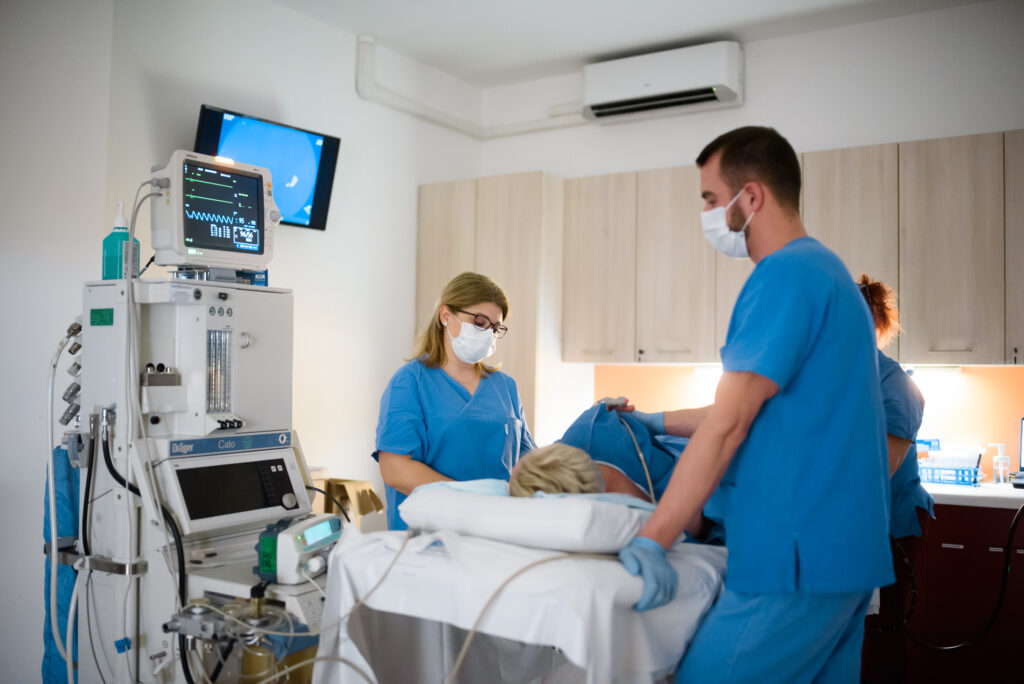
Monitored by an anaesthetistVital functions monitored throughout the procedure.
CO₂ insufflationCarbon dioxide is absorbed quickly, so no bloating remains.
Immediate samplingHelicobacter screening can be done while you are asleep under anaesthesia.
Eight situations where it is recommended
When is the examination recommended?
Gastroscopy shows the lining of the oesophagus, stomach and duodenum, with sampling if necessary. It is particularly advisable for the symptoms and situations below.
Reflux and burning pain
For persistent heartburn or acid regurgitation, at night or not responding to antacids.
Abdominal pain of unknown origin
To investigate pain, especially in the upper stomach area, whether it occurs independently of meals or after them.
Difficulty or pain when swallowing
If you feel that food gets stuck in your oesophagus, or swallowing is painful (dysphagia).
Anaemia, iron deficiency
If lab results show chronic iron deficiency or anaemia and the internal source needs to be found.
Sudden weight loss and loss of appetite
Unexplained, significant weight loss, which may raise the suspicion of a tumour.
Black stools or vomiting blood
Symptoms that need urgent investigation, as they may indicate bleeding in the upper digestive tract.
Family history (polyps, cancer)
If oesophageal or stomach cancer has occurred in a first-degree relative (parent, sibling).
Helicobacter pylori check
If infection is suspected or to check how effective treatment has been, with sampling (biopsy).
Does any of these symptoms sound familiar? Gastroscopy can also be requested under anaesthesia, without gagging.
This list is for information only and does not replace an examination by a specialist. If you are unsure which examination you need, call us: 06-1-413-2500 (H–P 9–17).
Two routes, the same diagnosis
Gastroscopy with and without anaesthesia
Both procedures offer the same diagnostic accuracy — the difference lies in what you feel during the examination and how your day goes after the procedure.
Under anaesthesia
Most popular choice
A painless experienceYou are comfortably asleep under anaesthesia during the examination and experience nothing of it, so unpleasant gagging is avoided.
Maximum calmComplete physical relaxation allows the doctor to examine the stomach lining undisturbed and with millimetre precision.
Safe supervisionDuring the procedure, a specialist anaesthetist monitors your vital functions, ensuring professional medical support.
Quick awakeningThanks to modern, short-acting agents, you wake up feeling fresh and rested, and after a short period of observation you can leave with a companion.
Without anaesthesia
Carry on straight awayNo observation or rest period is needed after the examination; you can carry on with your day and return to work straight away.
DrivingAs no sedation is given, you can drive straight after the examination and go home on your own, without a companion.
Staying in controlYou remain awake throughout the procedure, so you can stay in direct contact with your doctor and follow the course of the examination.
Minimal preparationThis diagnostic method requires the fewest preliminary tests (e.g. lab tests), so patients can be seen sooner.
From arrival to your report
The process step by step
Four steps: from check-in to a personal explanation of the results.
01
Arrival and check-in
We see our patients at a pre-arranged appointment; once the administrative details have been checked, our assistant accompanies you to the preparation room.
02
Anaesthetic consultation
Our specialist reviews your previous illnesses and lab results, then explains the process of safe anaesthesia given as intravenous sedation.
03
Examination (10–15 minutes)
You are peacefully asleep under anaesthesia while the gastroenterologist uses a thin, flexible instrument to examine the lining of the stomach and oesophagus thoroughly.
04
Waking up and evaluation
After a short period of observation, our doctor gives you the report straight away, explains the findings in detail and answers any questions you may have.
If you have anaesthesia, please come with an adult companion and do not drive on the day of the examination. You will receive your exact arrival time and preparation instructions when you book.
Three reasons to choose anaesthesia
Why choose gastroscopy under anaesthesia?
01
Completely free of pain and stress
We perform the examination under deep sedation with a safe intravenous anaesthetic, which ensures that you sleep undisturbed throughout the procedure. This completely switches off the unpleasant gag reflexes, retching and feeling of pressure, so the procedure is not only physically painless but also psychologically stress-free. Most of our patients experience the visit as a restful sleep, without unpleasant memories.
02
Maximum precision in diagnostics
The state-of-the-art high-definition (HD) endoscopy equipment used at Endomedix allows the stomach lining to be examined with millimetre precision. The stillness and relaxed muscles of a patient under anaesthesia create ideal conditions for the specialist, making the diagnosis much more thorough and faster. This calm setting also makes it possible to take precise samples immediately or to perform minor outpatient procedures.
03
Quick, clear-headed awakening
At our clinic, we use only modern, short-acting anaesthetics that are cleared from the body very quickly once the examination is over. This means that you regain a clear mind almost immediately after waking up and do not experience prolonged drowsiness or nausea. After a short, monitored rest period, you can leave safely with your companion and spend the rest of the day relaxing at home.
What you should know about gastroscopy under anaesthesia
Did you know?
Ten questions and answers about gastroscopy under anaesthesia.
Did you know that gastroscopy under anaesthesia completely eliminates nausea?
The deep sedation used during the examination switches off the gag reflexes, so you are spared unpleasant gagging and nausea. This method not only serves the patient's comfort but also allows the gastroenterologist to examine the stomach lining and oesophagus much more thoroughly in calm conditions.
Did you know that endoscopy under anaesthesia increases diagnostic accuracy?
Because the patient's body is completely relaxed under anaesthesia, the doctor can move the instrument more easily and quickly. The reflex-free state reduces unexpected movements during the examination, so the specialist can identify even the smallest signs of reflux, stomach ulcers or possible precancerous conditions with millimetre precision.
Did you know that waking up after gastroscopy under anaesthesia is quick and smooth?
Thanks to the gentle agents used in modern anaesthesia, patients wake up almost immediately after the procedure. After a short rest of 30–60 minutes in the recovery room, you can leave our clinic fully clear-headed and rested, avoiding the physical and mental exhaustion associated with conventional examinations.
Did you know that Helicobacter pylori screening can be done painlessly during the examination?
During gastroscopy under anaesthesia, the doctor can take a small tissue sample (biopsy) to detect the bacterium responsible for inflammation. As you are deeply asleep under anaesthesia, you feel nothing of this, and at the end of the examination you can get an immediate and accurate result on whether a stomach infection is present or not.
Did you know that gastroscopy under anaesthesia is the most effective answer to anxiety about the examination?
Many patients put off necessary investigations because of previous bad experiences or fear, which can make digestive diseases worse. The option of anaesthesia takes this psychological burden off your shoulders, so screening becomes a stress-free routine, helping to ensure that diseases are recognised and treated in time.
Did you know that anaesthesia is always supervised by a qualified anaesthetist?
At Endomedix, your safety comes first: a specialist anaesthetist and an assistant monitor your vital functions throughout the procedure. Continuous instrument monitoring ensures that the risk of gastroscopy under anaesthesia is kept to a minimum and that the examination takes place under the highest level of professional supervision.
Did you know that the chance of bloating after gastroscopy under anaesthesia is minimal?
At our clinic, we use special medical carbon dioxide to inflate the stomach for the examination, which is absorbed much faster than room air. As a result, you will not experience tight abdominal pain or troublesome bloating when you wake up from anaesthesia, making recovery even more comfortable and free of complaints.
Did you know that immediate therapeutic procedures are also possible during gastroscopy under anaesthesia?
If the specialist finds a suspicious lesion or a source of bleeding, they can carry out the necessary procedures straight away under anaesthesia. Whether it is haemostasis or sampling, these steps go completely unnoticed by the patient, avoiding later, more complicated surgical procedures.
Did you know that the CO₂ gas used for the examination is absorbed faster than room air?
We use carbon dioxide to inflate the oesophagus and stomach; it is absorbed through the mucosa much faster than room air. This means that no painful tension or abdominal cramps remain after the procedure, and after a short rest you can set off home free of complaints.
Did you know that bacteria can also be detected in a sample taken during gastroscopy?
A small tissue sample taken during the examination can confirm the presence of Helicobacter pylori within a short time. This bacterium is responsible for a large proportion of inflammation and ulcers, so once it is diagnosed we can prescribe a targeted course of antibiotics, which can prevent more serious digestive problems.
One anaesthesia, the entire digestive system: gastroscopy and colonoscopy can also be booked together.
The examination fee can of course also be paid from your health fund account — our colleagues will be happy to give you the details. The list of health funds that work with Endomedix can be found here.
Health fund accountThe gastroscopy and anaesthesia fees can both be paid from your health fund account.
*A kedvezmény csak az Endobiom – Bél Mikrobiom Vizsgálatra vonatkozik, más kedvezménnyel nem összevonható és 2026.10.15-18-ig vagy a készlet erejéig érvényes.